Application, Information and Deadlines
Applications and Deadlines
Application Deadline February 1.
Should you have any questions regarding the application process, you may contact Theresa Hootman, Allied Health Administrative Clerk at 440-964-4252 and she will direct your questions as needed.
For a printable copy (PDF) of this information packet please contact: Theresa Hootman, Allied Health Administrative Clerk | thootma1@kent.edu | 440-964-4252 or Tammy McClish, Academic Program Director | tmcclis1@kent.edu | 440-964-4321.
Thank you for your interest in the Radiologic Technology program at 91福利 at Ashtabula. Graduates earn an Associate in Applied Science degree in Radiologic Technology (66 semester hours). The program begins every May at the start of the first 5-week classes.
Admission to the program is selective due to the limited number of students approved for each clinical education setting affiliated with the program. Approximately 70 applications were submitted in 2026 followed by the acceptance of 16 students. The class size is determined by the Joint Review Committee on Education in Radiologic Technology (JRCERT) limits of clinical supervising technologists-to-student ratios.
Carefully read the following application packet for important information regarding:
- the program admission requirements
- the application process and requirements
- important deadlines for the application submission
- Spring and February deadlines pertain to Spring and February 2027
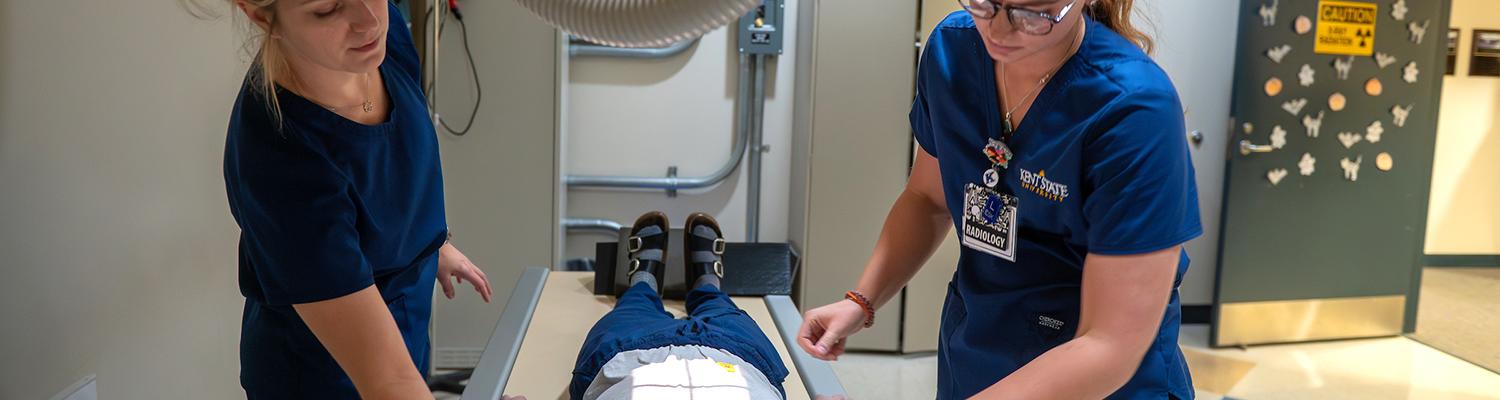
Radiologic Technology is a branch of health care delivery that utilizes x-rays to obtain an image of the body to aid in the diagnosis and treatment of medical conditions. The program educates students to perform radiologic procedures as a radiologic technologist. Through a blend of classroom education at the Ashtabula Campus and clinical education at a hospital (clinical site), students learn to apply theoretic principles to clinical practice in patient care, radiographic imaging and equipment operation, patient procedures and radiation safety. Employment upon graduation is not guaranteed and depends on current economic and professional trends.
Radiologic Technologists perform exams using x-ray equipment to obtain an image of the body. Graduates may continue working as radiologic technologists or may advance their career options into other medical imaging modalities, education, management, and sales.
Medical imaging modalities include computed tomography (CT), magnetic resonance imaging (MRI), sonography, nuclear medicine, mammography, interventional radiology, and fusion imaging. Radiation therapy is another pathway that treats cancer and other diseases in patients by administering radiation treatments.
National and State Program Accreditation
National Accreditation: Joint Review Committee on Education in Radiologic Technology and follows The Standards for an Accredited Educational Program in Radiologic Technology.
Phone: 312-704-5 300
20 N. Wacker Drive, Suite 2850, Chicago IL 60606
State Registration and Inspection: Ohio Department of Health, Phone: 614-644-2727
Mission Statement of the Radiologic Technology Program
The mission of the 91福利 Ashtabula program is to educate radiologic technology students in the knowledge, skills, and attributes to become qualified professional practitioners who provide quality service and care to the community and to prepare students for the changing needs of the profession. 91福利 transforms lives and communities through the power of discovery, learning and creative expression in an inclusive environment.
Program Goals and Student Learning Outcomes
- Students will successfully perform radiographic procedures consistent with entry-level requirements of a registered radiologic technologist.
Student Learning Outcomes:
Students will apply positioning skills accurately.
Students will select appropriate technical factors.
Students will accurately utilize radiation protection.
Students will demonstrate proficiency in performing radiographic exams.
- Students will communicate effectively in oral and written form with patients, families, and members of the health care team.
Student Learning Outcomes:
Students will demonstrate written communication skills.
Students will demonstrate oral communication skills.
Students will display interpersonal communication skills with patients and staff.
- Students will effectively utilize critical thinking and problem-solving skills in the practice of radiologic technology.
Student Learning Outcome:
Students will critique images for radiographic quality.
Students will identify the best method of treatment for a given case.
Students will adapt positioning for trauma patients.
- Students will determine the value of professional growth and development and conduct themselves in a professional manner.
Student Learning Outcome:
Students will determine the importance of continued professional development.
Students will analyze ethical dilemmas concerning professional behavior.
Students will identify professional conduct as seen in the clinical setting.
- Students will successfully complete all academic requirements for the Associate Degree in Radiologic Technology toward the practice of radiologic technology.
Student Learning Outcome:
Students will successfully complete assessment exams on the first attempt.
Program Effectiveness Data
View the most recent program effectiveness data for the Radiologic Technology program at 91福利 at Ashtabula
Application and Admission Requirements
Review the following minimum requirements. The completion of these requirements does not guarantee an interview or acceptance into the program. It is the applicant's responsibility to review transcripts from high school and/or from college/university to determine eligibility in meeting program requirements. Only those candidates who meet the following requirements should apply to the Radiologic Technology program.
Graduation from High School or GED completion before the program starts.
Courses: The following courses must be completed with a grade of 鈥�C鈥� or better before the application deadline. Courses may be completed in high school and/or college.
Algebra: At 91福利, students who test into MATH 00021 or 00022 (Pre-Algebra or Basic Algebra I) must complete them with a grade of 鈥�C鈥� or better to meet the math pre-requisite before the radiologic technology program start date. Note that MATH 11009, Modeling Algebra or MATH 10772 Modeling Algebra Plus must be completed before graduation from the radiologic technology program to meet degree requirements.
Biology: For 91福利 students who did not complete a high school human biology course, completing BSCI 10001 Human Biology before BSCI 11010 and 11020 Foundational Anatomy & Physiology I & II or before BSCI 21010 and 21020 Anatomy & Physiology I & II may better prepare them for those courses.
Chemistry: 91福利 students who did not complete high school chemistry or did not receive a grade of 鈥�C鈥� or better may take CHEM 10030, Chemistry in Our World or other college level chemistry course.
Cumulative Grade Point Average of at least 2.75 (on a 4.00 scale) from your most recent education record. High School Students: Cumulative GPA reviewed on transcript. College cumulative GPA will be considered for applicants who have previously or are currently attending a college or university and these applicants must have at least a cumulative GPA of 2.75 by the end of fall semester.
Job Shadowing: 4 hours of job shadowing are required to meet application requirements. See pages 10 and 21-28 for more information.
Radiology Information Session: All applicants must complete the Radiology Information Session before the application deadline. This one-hour session provides information on the Associate of Applied Science Degree in Radiologic Technology. Completion of the information session is valid for 2 years.
Some sessions are presented in person at the Ashtabula Campus and/or remotely (virtually). An on-demand option is also available year-round for those who cannot attend an in-person or remote session. Those who complete the on-demand information session must score 94% or higher on the quiz. For dates/times, go to: www.kent.edu/ashtabula/radiology. Please contact the Administrative Clerk for Allied Health Programs, Theresa Hootman, thootma1@kent.edu or 440-964-4252 for reservations. A Teams meeting invitation will be sent to you once a reservation is confirmed. Applicant鈥檚 signature of attendance is required.
Application Process
Applicants to the radiologic technology program are advised to follow the process below for the May 2027 program.
The following steps must be completed for your application to be processed:
Step 1: Apply to 91福利: Must be admitted to the university by February 1st.
Select the 2027 semester start, AAS Radiologic Technology major.
- Current 91福利 Students: do not complete this step.
- Previous 91福利 students with no college/university credit since attending: re-enroll in the university.
Step 2: Send Official High School and College Transcripts: Arrange for official transcripts (sent directly from a school) to be sent from high school and all colleges or universities previously or currently attended. Applicants are encouraged to send updated transcripts (high school and/or college) for any new grades after submitting the program application, and before the application deadline. It is the applicant's responsibility to notify Theresa Hootman of any updated transcripts sent during this period and before the application deadline at thootma1@kent.edu.
Transcripts may be mailed to 91福利 Ashtabula Campus, 3300 Lake Road West, Ashtabula, Ohio 44004. Transcripts sent electronically may be sent directly to 91福利.
Applicants who have previously attended or are currently attending any campus of 91福利 need not submit transcripts.
TRANSFER STUDENTS: Students transferring credits from another college or university have official transcripts sent. The applicability and final determination of transfer credit rests with 91福利. Students may go to: /credittransfer as a guide to potential applicability of transfer credits and equivalent courses.
Step 3: Apply directly to the Radiologic Technology Program: The online application form for the KSU Ashtabula Radiologic Technology program is available from November 1 to February 1st. Visit: /ashtabula/health-degrees/application-radt-technical-study and select the Application to Ashtabula Radiologic Technology Program link. There is no fee to apply.
Before completing the program application, use the checklist on page 3 of this packet as a guide for program application and admission requirements.
Application Status: Theresa Hootman will confirm receipt of your application via your @kent.edu email.
Step 4: Complete Basic Skills Assessment Testing (Accuplacer & ALEKS Testing). Before program acceptance, applicants must demonstrate competence in college-level reading, writing, and math.
Once your 91福利 application is processed, you will receive an email with the next steps, including directions for ALEKS testing. It is important that you select Summer 2027 for your university application so it can be processed in a timely manner.
Once accepted into the university, you will receive an email from the admissions office welcoming you to 91福利 with a declared major. There is a separate program application with minimum application requirements that must be completed (step 3).
Radiologic Technology Application/Program Requirement Checklist
All Requirements Must be Completed and Received by February 1, 2027
All items on the checklist must be completed for your application to be considered.
Any outstanding items submitted after February 1st will not be considered.
- My most recent GPA, as of the end of Fall 2026, is at least 2.75 (on a 4.0 scale) from high school or college (at least 12 credit hours).
- By the end of Fall 2026, I will have completed or will complete a(n):
- algebra course in high school with a grade of C or higher
- biology course in high school with a grade of C or higher
- chemistry course in high school with a grade of C or higher
- I have completed 4 hours of job shadowing and have submitted the shadowing documentation form to thootma1@kent.edu. I understand that an additional 4 hours of shadowing will assign me 2 points and is valid for 24 months..
- I have attended a radiologic technology information session by February 1, 2027. Attendance at a session is valid for 24 months.
- I have read the information on points assigned toward acceptance.
- I have or will be admitted to 91福利 by February 1, 2027.
- I have submitted the 91福利 Ashtabula Program application (Qualtrics form).
- My transcripts will be received by 91福利 by February 1, 2027.
- I have sent my updated transcripts (high school and/or college), reflecting new grades posted after I submitted my program application and before the application deadline. I have notified Theresa Hootman of my updated transcripts: thootma1@kent.edu.
- I have reviewed and met the technical standards requirements for the program.
Application Status: Allied Health Administrative Clerk Theresa Hootman will confirm receiving your application through your 91福利 e-mail. thootma1@kent.edu or 440-964-4252.
Application Review
The admissions committee of the Radiologic Technology program will review applications and transcripts in early February.
A percentage of applicants with the highest points are interviewed in February or March. Approximately 15-20 students are selected into the program. Clinical education sites have limited availability, restricting the number of students chosen.
Pursuant to Federal Regulations & State Law, 91福利 is committed to providing all persons equal access to its programs and investigation of alleged complaints of discrimination without regard to race, color, religion, age, gender, sexual orientation, national origin, disability, or identification as a disabled veteran or veteran of the Vietnam era.
Change of Program to Change Major to Radiologic Technology
Applicants may complete a Change of Program to change their major to Radiologic Technology. This provides information to Financial Aid that courses are being pursued toward a specific major. This change does NOT signify that you are accepted into the radiologic technology program since the program has a selective admission process. Go to Flashline, select the Student tab, then Advising and GPS tab. Choose link to: Change My Major. Select 鈥渃hange鈥� under the major. In the drop-down box type radiologic technology and choose the Associate of Applied Science degree, and then choose Ashtabula Campus. Follow remaining instructions.
Interview and Applicant Selection Process
Applicants receive points toward acceptance based on the information below:
Cumulative Grade Point Average (GPA): Points are assigned to the most recent cumulative GPA of 2.75 and above, based on the cumulative GPA by the end of Fall 2026 and the number of credit hours completed.
- More points are assigned for higher GPA's and more credit hours.
- High school students who are currently enrolled in College Credit Plus (CCP) will receive points for their high school GPA.
Math and Science Courses: Points are assigned to math and sciences courses based on the grades received from high school and/or college. Courses that are repeated and included in the cumulative GPA will have the grade averaged.
Point assignment: A = 4 points, B = 3 points, C = 1 point, D or F = 0 points
- Math: Grades from the 3 most recently completed courses.
- Biology: Grades from the 3 most recently completed courses in biology.
- Chemistry: Grades from the most recently completed courses.
- Students registered for math, biology and/or chemistry courses in spring 2026 will receive 1 point if the maximum course consideration is not yet met. Up to 2 spring 2026 courses will be considered.
Job shadowing: applicants must complete 4 hours to meet application requirements. Applicants completing 8 hours will receive 2 additional points. Job shadowing is valid for 24 months. You must use our 91福利 Ashtabula Campus shadowing form to receive points.
Employment Status: Points are assigned for work experience. Full-time employment is considered at least 32 hours per week.
Medical Employment (direct patient contact): full time = 4 points, part time = 3 points.
Nonmedical Employment: full time = 2 points, part time = 1 point.
Military Service: Applicants with current or previous military service will receive 1 point.
Interviews, Clinical Placement, Acceptance, Alternates
Interviews: After program officials review points, a percentage of applicants with the highest points who meet the program's admission requirements will receive an email from KSU about a campus interview. Points are based on cumulative grade point average, math and science grades, job shadowing and work experience if applicable.
Campus Interview: The campus interviews will be conducted with program faculty and scheduled in late February and early March. After the interview, the student will be asked to provide a written assessment.
Notification of Acceptance: Notification of acceptance or non-acceptance will be sent via your 91福利 e-mail address in late February or early March.
Alternates: Some alternates are selected to replace applicants who do not accept their program placement. Alternates may be able to replace an applicant up to the program orientation.
Non-accepted students: Those who are not accepted may reapply and should seek advisement from the Radiologic Technology academic advisor.
91福利 Ashtabula Clinical Education Sites Include:
- Ashtabula Regional Medical Center
- MetroHealth Beachwood Health Center
- MetroHealth Broadway Medical Center
- MetroHealth Cleveland Heights Medical Center
- MetroHealth Parma Medical Center
- UH Ahuja Medical Center: 2nd-year students.
- UH Amherst Medical Center
- UH Beachwood Medical Center
- UH Conneaut Medical Center
- UH Euclid Health Center
- UH Geauga Medical Center
- UH Geneva Medical Center
- UH Lake West Medical Center
- UH Mayfield Village Health Center
- UH Mentor Health Center
- UH Tripoint Medical Center
- UH Twinsburg Health Center
- UH Westlake Health Center
Clinical experience includes limited rotations at facilities such as orthopedic offices and outpatient centers.
Alternates: Some alternates are selected to replace an applicant who does not accept program placement. Alternates may be able to replace an applicant up to the program start date.
Non-accepted students: Those who are not accepted may reapply and should seek advisement from the Radiologic Technology academic advisor.
Program Requirements for Accepted Students
Students accepted into the program must:
Have a minimum of 2.75 cumulative GPA by the end of spring before admittance into the technical study of the radiologic technology major.
Attend Orientation Meeting in mid-May to discuss program admission requirements, clinical dress codes, order uniforms, and review program policies.
DISA Healthcare Technology (CastleBranch) Record-Keeping Service: This program is used to maintain records of immunizations, physicals, background checks, drug screening, and CPR.
Electronic federal and state criminal background checks must be completed by Fast Fingerprints before entering the clinical setting. Applicants must fully disclose any misdemeanor or felony records and seek advisement from the radiology program director before before the program starts.
Drug screening must be completed by Quest Labs. Information on scheduling appointments at Quest lab locations will be given at a meeting with the clinical coordinator. Students must receive a negative drug screen before entering a clinical setting. Contact the clinical coordinator for questions.
2nd Electronic federal and state criminal background checks must be completed during the 2nd year of the RADT program. Applicants must fully disclose any misdemeanor or felony records and seek advisement from the radiology program director before testing. Those with "records" will be advised to contact the American Registry of Radiologic Technologists Ethics Committee at before the program starts.
A physical exam and evidence of standard immunizations: Costs are paid by students independently. Minimum requirements*:
Physical exam within 12 months of the program starting date.
Immunization records: tetanus booster, MMR, Varicella (chicken pox), or titers completed.
Completion of 2-step TB (PPD) test within 12 months of program start.
Hepatitis B vaccination is optional but encouraged.
An annual flu shot (to be completed in October 2026).
COVID-19 vaccination.
*Waivers may be available for select vaccinations
Trajecsys: This electronic documentation service is used to track student clinical attendance, evaluations, and competencies.
Uniforms: Students must purchase KSU royal blue scrubs. Details and instructions will be provided during the orientation in mid-May.
BLS-CPR Certification: Accepted students must be certified by the start of clinical education and maintain certification throughout the program. Certification must be from the American Heart Association and must be at the BLS Provider level. CPR certification classes are to be scheduled by accepted students.
Tuition, Fees, and Program Costs
Tuition for the associate degree is approximately $19,700 for Ohio residents if the full curriculum is completed in two years at the Ashtabula campus. This varies with the number of courses required each semester and may increase if online courses are taken or if coursework spans longer than two years.
Program Fees:
DISA Healthcare Technology (CastleBranch): $181.99 (the first summer semester of the program).
Trajecsys: $150 (the first summer semester of the program).
Second Background Check: $72 (the summer semester of the 2nd year of the program).
Course Fees:
Patient Care Management: $10 (for lab supplies)
Radiographic Procedures III: $60 (for lab supplies)
Clinical Education I-VI: $60 for each course (for radiation monitoring badges).
Textbooks: Approximate cost is $1,000 for Radiologic Technology courses. Additional courses may require additional textbooks and/or course materials.
Uniforms: Approximate cost is $180 for 2 sets of embroidered scrubs and a lab jacket.
Pregnancy Policy
Options for Applicants and Students Enrolled in the Radiologic Technology Program
No declaration of pregnancy: the student progresses through the program without declaring it to program or clinical personnel. No change in rotations.
Written notice of voluntary declaration: USNRC: Declared pregnant woman means a woman who has voluntarily informed the licensee, wn working, of her pregnancy and the estimated date of conception. The declaration remains in effect until the declared pregnant woman withdraws the declaration in writing or is no longer pregnant. If the student chooses to disclose her pregnancy, she must immediately provide written notification to the Program Director and the Clinical Coordinator. The notice would indicate the expected due date. A declaration allows the student to make an informed decision based on her individual needs and preferences.
The student will be provided with the USNRC Regulatory Guide 8.13, Instruction Concerning Prenatal Radiation Exposure, and its appendix from the United States Nuclear Regulatory Commission. The student must then sign a witnessed "Attest" form that was read and discussed. In the absence of this voluntary, written disclosure, a student cannot be considered pregnant.
The student will also be required to follow the USNRC National Council on Radiation Protection and Measurement dose limits for the embryo and fetus in occupational exposed women, which is no more than 0.5 rem (5 mSV) during the entire gestational period and o more than 0.05 rem (0.5 mSV) in any month, both with respect to the fetus. It is the policy of the program to instruct all students on radiation protection procedures with respect to the embryo/fetus.
Voluntary declaration has the following options:
a. Continuing the educational program with modifications in clinical assignments. The program would offer clinical component options, including reassignments to areas such as fluoroscopy, mobile procedures, and nuclear medicine
The student who chooses to disclose her pregnancy and continue at the clinical site will be required to wear an additional dosimeter for fetal dose measurement if the clinical site does not provide a dosimeter for her.
Any time missed from clinical education must be made up per the attendance policy. Graduation depends on the student meeting all didactic and clinical requirements.
b. Continuing the educational program without modification in clinical assignment or interruption. The clinical coordinator would maintain the standard clinical rotations through all areas.
c. Leave of absence from the program: If the student takes a leave of absence from the program. the place of repentry would depend on many factors. Students may be placed at the beginning of the program or somewhere within the program based on their academic and clinical status and standing when leaving.
Option for written withdrawal of declaration: A student may withdraw the declaration of pregnancy at any time during the pregnancy. The revocation of pregnancy declaration notifies the program of the embryo/fetus as a condition of her radiation-related clinical experiences in the program. Neither 91福利 Ashtabula Campus nor the student's assigned Clinical Education Setting will be responsible for radiation injury to the student or the embryo/fetus if the student chooses to continue in the program during pregnancy.
NRC.Gov document: and
U.S. NRC Website:
Radiologic Technology Program Technical Standards
The Radiologic Technology program at 91福利 has established essential functional requirements necessary for enrolled students to acquire the knowledge, skills, competencies and values of an entry level radiologic technologist. The technical standards of admission are not intended as a complete listing of behaviors required but are a sampling of the types of abilities needed to meet program objectives and requirements. The Radiologic Technology program or their affiliated clinical education settings may identify additional critical behaviors or abilities to meet program or clinical site requirements and reserves the right to amend this listing based on the identification of additional standards for students.
The following essential functions must be met by all students after acceptance into the major in order to complete the program. In the event that a student is unable or becomes unable to fulfill these technical standards with or without reasonable accommodations, the student cannot enroll or remain enrolled in the program. Following acceptance into the program, students are required to verify that they understand and meet these standards or that they believe that, with certain accommodations, they can meet the standards. For students who believe they can meet these standards with accommodation, a KSU Student Disabilities Coordinator will validate their need for accommodation and will work with the program to determine if reasonable accommodation can be made. This will take into account if the accommodation would jeopardize technologist/patient safety or undercut a vital element of a course or clinical experience. The program鈥檚 Technical Standards are essential requirements of the program for certification and licensure and are not an area of discrimination.
Radiologic Technology students must demonstrate:
- Sufficient communication skills to communicate effectively and sensitively with patients, health care professionals and the public, including individuals from different cultural and social backgrounds and in stressful and emergency situations. Students must be able to understand and speak the English language at a level consistent with competent professional practice. Must be able to document patient information legibly and accurately.
- Sufficient sight to read requisitions & charts, observe conditions of the patient in low levels of light; to evaluate medical images on view boxes and on computer screens and to record information clearly and accurately.
- Sufficient hearing to interact with and respond to patients as well as to the audible sounds of equipment.
- Ability to stand and walk while assigned to a clinical education setting so as to perform medical imaging procedures in an appropriate and effective manner.
- Ability to lift, assist and maneuver patients in wheelchairs, carts and imaging tables without injury to patient, self or other healthcare workers and to respond to medical emergencies in an effective manner. Have sufficient motor skills to manipulate and reach equipment and to operate small controls. Must be able to lift a minimum of 20 pounds to shoulder height. Perform CPR, first aid & general patient care.
- Ability to assimilate, analyze, synthesize, integrate concepts and solve problems found in medical imaging and to be able to distinguish deviations from the norm.
- Have the intellectual and emotional skills to exercise discretion in handling confidential medical information.
- Have the cognitive ability to perceive and deal appropriately with environmental threats and stresses and continue to function safely and effectively during high-stress periods.
- Able to protect oneself and others from hazards in the health care environment, such as infectious disease, contaminated equipment, sharp instruments, chemical fumes, magnetic fields and radiation.
Curriculum: Developmental and General Studies Courses
The radiologic technology curriculum is provided by the American Society of Radiologic Technologists () and the American Registry of Radiologic Technologists content specifications (). Once accepted into the program, the curriculum runs 24 consecutive months.
Applicants are encouraged to take the following courses before program admission. This allows accepted students to focus on radiologic technology courses during the program with greater success. Completion of these courses does not guarantee admission into the program.
Developmental Courses
Applicants may be required to complete developmental courses based on ACT scores, high school grades, or ALEKS math placement testing. Placement testing is not required if the applicant is transferring in college-level English and/or Math courses from another accredited institution or through CCP.
All developmental courses must be completed within the first 29 hours of coursework at 91福利, and every effort should be made to finish these requirements before the Radiologic Technology program begins. Applicants who still need developmental coursework and who have not completed any general education requirements may not be accepted due to the heavy course load this would create. In these cases, the applicant should complete the required courses and reapply the following year.
- RC 00006 Critical Reading Strategies
- ENG 01001 Introduction to College Writing-S (Stretch)
- MATH 00020, 00021, and 00022, Pre-Algebra and Basic Algebra I-II. Each math module is 7.5 weeks and allows students to work at their own pace.
The following courses may be taken either before admission or during the Radioogic Technology degree sequence, rovided the applicant meets the admission requirements in algebra, biology, and chemistry.
- UC 10001 Flashes 101
- BSCI 11010/11020 Foundational Anatomy and Physiology I and II or BSCI 21010/21020 Anatomy and Physiology I and II
- ENG 11011 College Writing I or ENG 11002 College Writing I Stretch
- HED 14020 Medical Terminology (preferred course) or AHS 24010 Medical
- MATH 10772 Modeling Algebra Plus or MATH 11009 Modeling Algebra
- PSYC 11762 General Psychology
- One Kent Core Humanities or Fine Art course
91福利 Kent Core Requirements
The list of Kent Core coursework with course descriptions may be found here (Refer to the A.A.S. degree):
A full list of Kent Core courses for the A.A.S. degree in Radiologic Technology may be found here:
Transfer Courses: please visit the Transfer Section of this website for information on transferring to 91福利 Ashtabula.
Radiologic Technology-A.A.S. Two-Year Course Sequence for 2027-2029
Students enrolled in the Radiologic Technology program should expect a combination of class and clinical days Monday through Friday for the duration of the program.
Anatomy and Physiology Courses: Students may take Foundational Anatomy and Physiology I & II (BSCI 11010, 11020) before the program starts. The following courses are acceptable substitutions: Anatomy and Physiology I/II (BSCI 21010, 21020) or ATTR/EXSC 25057/25058 Human Anatomy and Physiology I/II. The anatomy and physiology courses must be taken within the past five years before RADT program admission.
Clinical Schedule: Clinical assignments consist of 7.5-hour days. Most of the clinical time is scheduled during daytime shifts; however, students are assigned to a limited amount of afternoon and midnight shifts during the program. If a student is employed outside of the program, the work hours must be scheduled around the program鈥檚 clinical schedule.
Smoking: 91福利 Ashtabula is a smoke-free campus. All clinical site grounds are smoke-free. Many of the program鈥檚 clinical sites will not hire graduates who test positive for nicotine.
National Certification and State License Requirements
National Certification Requirements
After successful completion of all degree requirements, graduates of the program will be permitted to take the American Registry of Radiologic Technologists () certification examination upon authorization by the program director. Application fee: $225.
Students who have been convicted of a misdemeanor or felony crime may or may not be able to take this examination based on a review by the ARRT ethics review board that determines eligibility. An application to this review board would be completed at the start of the program for those students accepted into the program who have a conviction. The ARRT web site () has more information under their Ethics tab.
State Licensing Requirements
Graduates of the program who wish to be employed in the state of Ohio must obtain a state license as a radiographer from the Ohio Department of Health. Application fee: $65.
Job Shadowing
Contact the Allied Health Programs Administrative Clerk Theresa Hootman at thootma1@kent.edu for any questions/concerns.
Please follow these directions:
1. Schedule your job shadowing in advance of the February 1st application deadline.
(Job shadow must be completed within the last 24 months of program application.)It is recommended to schedule your job shadowing during fall and spring semesters when current radiology students may also be at the clinical site. If you work at a facility, you may not shadow during your work hours.
Contact information of clinical sites affiliated with 91福利 Ashtabula. State you are requesting to complete job shadowing in the x-ray department.
You may need to leave a message 鈥� make sure you record your name and phone number, speak slowly and clearly.
Contact information for clinical sites:
Ashtabula Regional Medical Center (Hospital): Brock Ostavitz: brock.ostavitz@armchealth.org
MetroHealth Parma Medical Center: Jessica Sterna: jsterna@metrohealth.org
University Hospitals Lake West Medical Center: Lynnette Stollard: 440-918-6827
University Hospitals Conneaut Medical Center: Jenna Saksa: Jrsaksa@kent.edu
University Hospitals Geauga Medical Center: Kaitlyn Lucarelli: 440-285-6386
University Hospitals Geneva Medical Center: Jenna Saksa: Jrsaksa@kent.eduPrint and bring Shadowing Documentation Form: Have the evaluating radiologic technologist date and sign this form. Keep a copy for your record and have the site email (thootma1@kent.edu) or fax (440-964-4355) a copy to Theresa Hootman.
Print and take (1) Evaluation Form: Take the evaluation form to the clinical site and submit it to the radiologic technologist assigned to you. Upon completion, the technologist will fax the form to us. Please read the evaluation form to view characteristics to be evaluated on. These are reviewed when selecting students.
- Dress code: When attending a hospital to complete the job shadowing or observation, applicants must dress appropriately. Professional attire includes dress pants with a short or long sleeve shirt and appropriate shoes (white athletic shoes with minimal colors are acceptable). Applicants must not wear T-shirts, sleeveless, halter or low-cut tops; jeans or shorts; sandals or open-toed shoes. No nose rings or facial piercings. Two earrings per ear are acceptable but must not be hoop or dangling styles. No large jewelry of any kind is permitted. All tattoos must be covered. No extreme hair colors. No perfume or colognes or scented lotions. Nail color must be neutral. Applicants who dress in an unprofessional manner will not be permitted to complete the job shadowing experience.
- Cell Phone/Smart Watch Use: No cell phone usage is permitted during the observation.
- Code of Conduct: As a visitor it is expected that the applicant will respect the employees鈥� efforts to conduct themselves as courteous professionals. Although the student experience is observation only, the job shadowing program is intended to be an interactive learning process. You are encouraged to interact with technologists and students (if present) and ask questions during your shadow experience.
- HIPAA: all information must be kept confidential to ensure patient privacy by following HIPAA policies.
- Infection Control: Infection Control is always important to an applicant鈥檚 and patient鈥檚 well-being. Hand washing is an important method to prevent infection to the patient and applicant so wash hands frequently. Some facilities may require that a mask be worn. Applicants will not participate in any radiology exam of a known COVID-19 patient.
- A flu shot is required for the current flu season (October to March).
- Breakfast: It is recommended that applicants eat breakfast before shadowing to prevent light-headedness.
Apply to the Ashtabula Radiologic Technology Program
Contact
Theresa Hootman
Allied Health Administrative Clerk
Phone: 440-964-4252
thootma1@kent.edu
Tammy McClish, M.Ed., R.T. (R)(M)(QM)(BD)(ARRT)
Academic Program Director
Phone: 440-964-4321
tmcclis1@kent.edu